


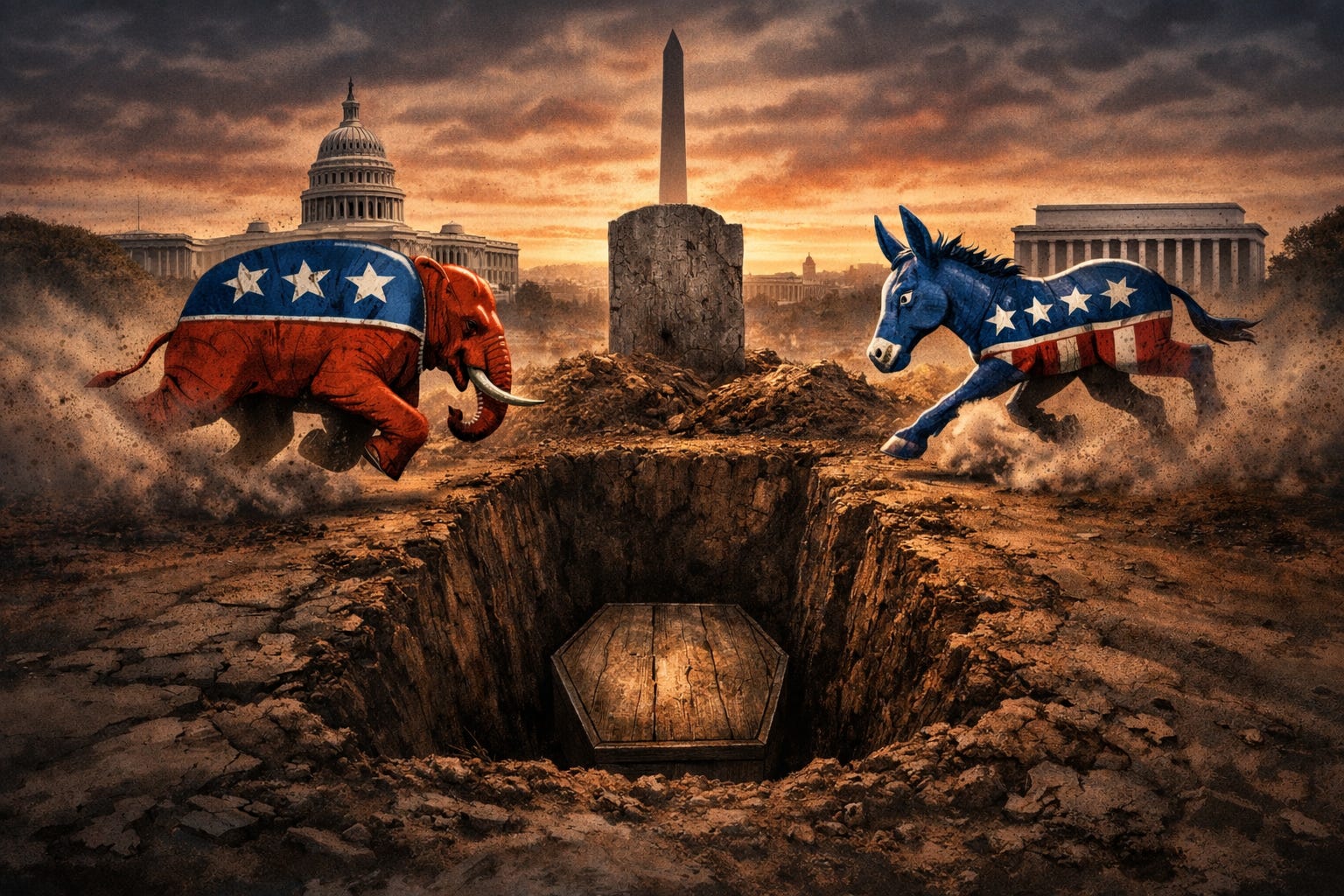
What we have seen in the last 6 years is astonishing, to say the least. As Trump’s popularity fell to its lowest point in his second term at -17.5% a few days ago1, Democrats' popularity is hovering around 28%, with Republicans slightly ahead at 32%.2 Trust in the government as a whole looks less grim at first glance, with 19% of Americans trusting the government a “great deal,” the highest it has been in almost 20 years; however, when looking closer, only 26% of Americans trust the government a “fair amount,” the lowest it has been in almost 20 years.3 This is a race to the bottom, and the loser is everyone.
What makes this moment different is not simply that both parties are unpopular—it’s that their unpopularity is now mutually reinforcing. Each side derives its remaining strength not from public confidence, but from public fear of the other. In other words, the modern political economy is no longer built on persuasion, but on aversion.
This is the quiet transformation that has taken place over the last decade. Democrats are not winning because they inspire broad trust; Republicans are not holding ground because they command widespread approval. Both are surviving because the electorate has been conditioned to see the other as an existential threat. The result is a system where declining approval is not a liability; rather, it is a feature.
In that environment, there is little incentive to course-correct. Moderation does not win primaries. Competence does not drive engagement. Outrage does. The more polarizing the figure, the more durable their base; the more dysfunctional the system, the easier it becomes to justify its continuation. Each party, in its own way, is rewarded for decay.
This is why the numbers matter less as individual data points and more as indicators of where we are going. When trust in government declines alongside trust in both parties, it signals something deeper than dissatisfaction—it signals detachment. Americans are not just losing faith in leaders; they are losing faith in the idea that leadership, as currently structured, can produce meaningful outcomes at all. And yet, the system persists. Not because it is working, but because it has become self-sustaining.
History & Modernity
If this moment feels unprecedented, it’s worth asking whether it actually is. American politics has endured periods of deep fracture before—Reconstruction, the Gilded Age, and the late 1960s. Trust has collapsed, parties have realigned, and institutions have strained under the weight of internal conflict. But in each of those eras, at least one political force was in ascent, offering a vision—however flawed—that could plausibly replace what was breaking down.
That is what makes today different. There is no clear ascent. There is no emerging consensus. There is no political home that a disillusioned electorate can migrate toward with confidence. Instead, two institutions are declining in parallel, each too weak to command trust, yet strong enough to block alternatives. It is not a realignment. It is a stalemate.
History suggests that systems do not remain in this state indefinitely. When public trust erodes to this degree, something eventually gives. The question is not whether the current structure will change—it is how.
The metaphor of a “race to the bottom” implies a finish line. But what lies at the bottom is not victory for one party over the other. It is something closer to a grave—a burial of legitimacy, of shared reality, of the basic assumption that the system can correct itself through normal means. When both parties arrive there together, the contest itself becomes irrelevant. And when legitimacy collapses, the pathways forward narrow quickly.
Correcting the System
In the best case, collapse forces reform. New coalitions emerge, institutional rules are rethought, and political incentives are rebuilt around performance rather than polarization. American history offers examples of this kind of renewal, but they are rare—and almost always born of prolonged instability rather than proactive change.
In the worst case, collapse does not produce reform—it produces acceleration. Distrust deepens, governing becomes more erratic, and voters increasingly look outside the system for answers. Not necessarily toward any coherent alternative, but toward disruption for its own sake. The demand shifts from “fix it” to “break it.” We are not at that endpoint yet. But the trajectory is clear.
The danger is not that Americans will suddenly lose faith in democracy overnight. It is quieter than that. It is the slow normalization of dysfunction—the steady acceptance that nothing works, that no one is accountable, that every election is simply a choice between two diminishing options. Systems do not collapse all at once; they erode until the public stops expecting anything better. And once that expectation disappears, it is extraordinarily difficult to recover.
The uncomfortable truth is that there is no sweeping reform waiting in the wings. No single election, no outsider candidate, no procedural tweak is going to reverse a decades-long realignment of incentives. If the system is going to correct, it will not happen through a grand reset. It will happen through smaller, less satisfying changes that alter incentives at the margins. That begins with competition. Not ideological purity, not a perfect third party, but the reintroduction of real political risk. Open primaries that force candidates to appeal beyond their base. Ranked-choice voting that rewards coalition-building instead of plurality wins. Structural changes that make it harder to win by simply being less hated than the alternative.
What’s Next?
None of these is a silver bullet. But they do something more important: they change the math. They make it possible—if not yet likely—for candidates to win by expanding trust rather than exploiting division.
Without that shift, the trajectory holds. The parties will continue to decay in parallel, insulated by the very system that should be disciplining them. The race will continue, not toward victory, but toward mutual exhaustion. And at the bottom, there will be no winner—only the realization that the system did exactly what it was designed to do, long after it stopped delivering what it was meant to provide.
The question now is whether we are willing to change those incentives while the system still has the capacity to respond—or whether we will wait until the grave is no longer a metaphor.