


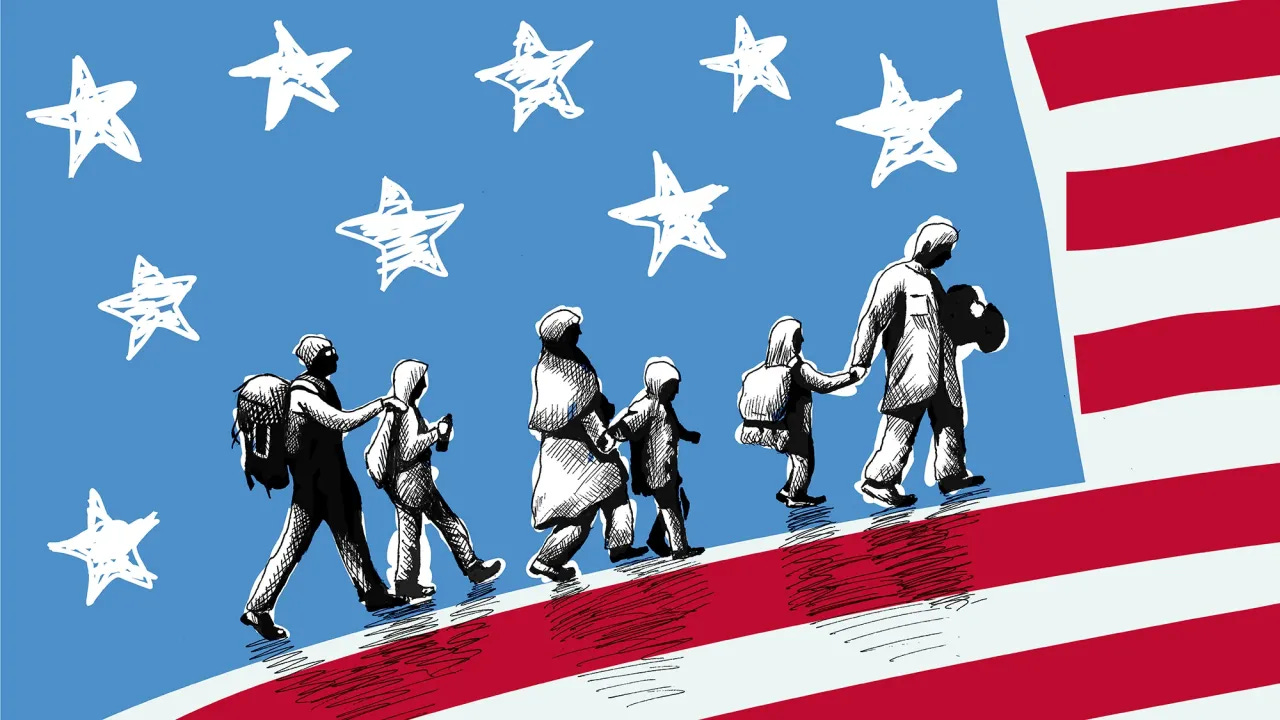
Representative Roy (TX-21) introduced the Measures Against Marxism’s Dangerous Adherents and Noxious Islamists (MAMDANI) Act of 2026. This bill would limit eligibility for admission and naturalization as well as allow for the deportation and denaturalization “for any membership, affiliations, or advocacy of socialist, communist, Chinese communist, Marxist, or Islamic fundamentalist doctrines.” This modern-day Red Scare aims to denaturalize citizens who are “affiliated” with communism, its socialist counterpart, or Islam. This, presumably unconstitutional, bill marks a much deeper shift in the understanding of what it means to be a citizen of the United States of America in the 21st Century.
Subtle & Not-So-Subtle Language
The bill’s language is sobering, to say the least. Some of the language modifications are subtle (e.g., replacing “and” with “or”). In contrast, some modifications are more brazen (e.g., in paragraph (4), by striking ‘‘advocates or teaches or who is’’ and inserting ‘‘advocates or advocated, who teaches, or who is or was’’). Much of the bill amends existing language from the present tense to the past tense (e.g., “causes” to “caused”). The bill also changes the age at which you are not held liable for your previous subscriptions from 16 to 14. Ensuring that almost everyone, including minors, who ever subscribed to such views, can be denied entry or denaturalized. The bill makes clear what it means, albeit vaguely, to be affiliated with such groups:
Any alien who has engaged, is engaged, or at any time after admission engages in advocacy for communism, Chinese communism, socialism, Marxism, or Islamic fundamentalism; writing, distributing, circulating, printing, displaying, possessing, or publishing any written, electronic, or printed matter that advocates for (groups) or has been a member of or affiliated with, is a member of or affiliated with, or at any time after admission becomes a member of or affiliated with (groups) or an organization that advocates communism, Chinese communism, socialism, Marxism, or Islamic fundamentalism, or a predecessor, successor, or front for such organization, is deportable and shall be removed from the United States.
The word choice is strategic, as the point is not only to keep out or remove those who espouse these views; instead, it is to make it impossible for those who may have possessed material related to views, even if they may not be held by the individual. This law could make it illegal to bookmark an article law makers deem “socialist.” It holds 14-year-olds accountable for vague violations and punishes those who may have once held a belief that is no longer harbored. The sweeping language of the bill is designed to punish those whom the existing hegemony sees as pests. Is this a violation of the First Amendment? Is this bill legal under the Fourteenth Amendment? To figure that out, we first must analyze the precedent that suggests either a constitutional or an unconstitutional nature.
Precedent vs Prejudice: 1st & 14th Amendments
First Amendment
Congress shall make no law respecting an establishment of religion, or prohibiting the free exercise thereof; or abridging the freedom of speech, or of the press; or the right of the people peaceably to assemble, and to petition the Government for a redress of grievances.
First, it is important to understand that freedom of speech is a foundational and deeply cherished part of the United States’ law. In Brandenburg v. Ohio, 395 U.S. 444 (1969), the court held that “a state may not forbid speech advocating the use of force or unlawful conduct unless this advocacy is directed to inciting or producing imminent lawless action and is likely to incite or produce such action.” Accordingly, a person cannot be punished for speech unless that speech directly incites violence or lawless action. Even when speech advocated against the system, for violence, or for unlawful action, First Amendment protections are still observed and are only revoked when that advocacy leads directly to action. This doesn’t mean that advocacy for a differing view is legal until violence breaks out, but rather that advocacy is legal until one’s words lead to specific unlawful action. The court makes clear what criteria must be met before First Amendment protections are revoked: “To impose criminal liability for speech that incites others to illegal actions, imminent harm, a likelihood that the incited illegal action will occur, and an intent by the speaker to cause imminent illegal actions.” Until these criteria are met, advocacy, even for unlawful actions, is protected.
Second, the court agreed in Iancu v. Brunetti, 588 U.S. (2019) that “the government may not discriminate against speech based on the ideas or opinions it conveys,” and if a statute discriminates against such speech, it violates the First Amendment. And in Texas v. Johnson, 491 U.S. 397 (1989), “expression may not be prohibited on the basis that an audience that takes serious offense to the expression may disturb the peace,” (491 U. S. 398). By singling out specific ideologies and excluding competing ideas, the bill attempts to limit what speech is allowed for certain groups. This is also likely a violation of the due process clause, but more on that later.
Finally, in West Virginia State Board of Education v. Barnette, 319 U.S. 624 (1943), the court noted: “To believe that patriotism will not flourish if patriotic ceremonies are voluntary and spontaneous, instead of a compulsory routine, is to make an unflattering estimate of the appeal of our institutions to free minds. We can have intellectual individualism and the rich cultural diversities that we owe to exceptional minds only at the price of occasional eccentricity and abnormal attitudes. When they are so harmless to others or to the State as those we deal with here, the price is not too great. But freedom to differ is not limited to things that do not matter much.” The importance of individualism is central to the First Amendment, as diverse expression, ideas, and cultures are precisely what make the United States different from its European and North American counterparts. To limit the freedoms of certain cultures, ideologies, and advocacy under the guise of “national security” instead of what it really is—ideological purity—is fundamentally un-American.
Opposing Precedent
It is important to understand cases that suggest parts of this legislation could be upheld in court. Harisiades v. Shaughnessy, 342 U.S. 580 (1952), held that the government was within its rights to deport non-citizens for past communist party membership; however, this does not apply to citizens. The court held that deportation was a civil proceeding rather than a criminal one, but one that, again, applies only to non-citizens. Nevertheless, in this case, the court clarified that ambiguity was a valid concern: “So long as the alien elects to continue the ambiguity of his allegiance, his domicile here is held by a precarious tenure” (342 U.S. 587). The court later restricted the government’s ability to restrict the speech of non-citizens, although Harisiades v. Shaughnessy was not overturned. In American Association of University Professors et al v. Rubio et al (2025), the court held that deportations based on political expression violate the First Amendment. Judge Young wrote, “although case law defining the scope of noncitizens’ First Amendment rights is notably sparse, the Plaintiffs have at least plausibly alleged that noncitizens, including lawful permanent residents, are being targeted specifically for exercising their right to political speech,” (55-56). Judge Young makes an important point that precedent regarding non-citizens’ First Amendment rights is sparse, but clarifies that this sparsity does not mean they can be targeted specifically for exercising those rights. This makes the bill’s constitutionality ambiguous at best, and a blatant violation at worst.
Fourteenth Amendment, Section 1
All persons born or naturalized in the United States, and subject to the jurisdiction thereof, are citizens of the United States and of the State wherein they reside. No State shall make or enforce any law which shall abridge the privileges or immunities of citizens of the United States; nor shall any State deprive any person of life, liberty, or property, without due process of law; nor deny to any person within its jurisdiction the equal protection of the laws.
The Fourteenth Amendment remains another enormous hurdle for this bill, as depriving any person (citizen or non-citizen, regardless of legal status) of due process is unlawful. But to properly understand its application, I will analyze it in two contexts: citizens and non-citizens.
Citizens’ Protections & Limits
In Afroyim v. Rusk, 387 U.S. 253 (1967), the court held that, “Congress has no power under the Constitution to divest a person of his United States citizenship absent his voluntary renunciation thereof,” and later clarified, “the [Fourteenth] Amendment can most reasonably be read as defining a citizenship which a citizen keeps unless he voluntarily relinquishes it. Once acquired, this Fourteenth Amendment citizenship was not to be shifted, canceled, or diluted at the will of the Federal Government, the States, or any other government unit” (262-63). The government’s ability to revoke citizenship is limited, and even then, it seems revocation is allowed when citizenship is gained through fraud, and there is little exception to this rule (see Maney v. United States, 278 U.S. 17 (1928); Fedorenko v. United States, 449 U.S. 490 (1981)).
The court wrote in Schneider v. Rusk, 377 U.S. 163 (1964) that “This statute (i.e., § 352(a)(1) of the Immigration and Nationality Act of 1952) proceeds on the impermissible assumption that naturalized citizens as a class are less reliable, and bear less allegiance to this country than do the native born. This is an assumption that is impossible for us to make. Moreover, while the Fifth Amendment contains no equal protection clause, it does forbid discrimination that is ‘so unjustifiable as to be violative of due process’” (214). The court made clear, as does the Constitution, that citizenship does not have a class structure, but rather it applies equally to all. In Perez v. Brownell, 356 U.S. 44 (1958), the court held that “anyone who votes in a foreign political election shall lose his American citizenship.” In Perez, the plaintiff was a birthright citizen, which further strengthens the idea that to lose citizenship is not subject to the kind of citizen, and the bar is astronomically high for one to lose said protections. This bill attempts to build out a class structure that applies the law differently across citizens, which does not exist and cannot legally exist.
Non-Citizens Protections & Limits
The case for non-citizens is slightly less obvious, but existing case law does offer some protections to non-citizens. In Yick Wo v. Hopkins, 118 U.S. 356 (1886), the court expressed: “The guarantees of protection contained in the Fourteenth Amendment to the Constitution extend to all persons within the territorial jurisdiction of the United States, without regard to differences of race, of color, or of nationality.” The Fourteenth Amendment does not discriminate between citizens and non-citizens, as the language of the amendment is clear—“all persons.” To suggest that non-citizens are less protected under the Fourteenth Amendment is to ignore its explicit language. Plyler v. Doe, 457 U.S. 202 (1982) the court reaffirmed precendent set in Yick Wo v. Hopkins, “concluding that ‘all persons within the territory of the United States,’ including aliens unlawfully present, may invoke the Fifth and Sixth Amendments to challenge actions of the Federal Government, we reasoned from the understanding that the Fourteenth Amendment was designed to afford its protection to all within the boundaries of a State.” The court’s consistent application of the Fourteenth Amendment’s Equal Protection Clause suggests that this bill, even if just applied to non-citizens, may fail to stand on any real constitutional footing. Although the case law for non-citizens is not as straightforward as it is for citizens, the courts seem to hold that protections still exist for non-citizens and that “all persons” does not mean “only citizens.”
Chaos With A Clear Conclusion
Immigration has become a hot topic all around the world, with Canada tightening restrictions1 and Europe closing its once-open doors2. In the United States, Trump ran on cracking down on unlawful immigration; unlawful immigration crackdowns just so happen to include lawful immigration; blanket immigration crackdowns now include naturalized citizens. It is not hard to see the progression, and it is not ignorant to think that progression will continue. Pastor Martin Niemoller’s poem, First They Came, comes to mind:
First they came for the Communists
And I did not speak out
Because I was not a Communist
Then they came for the Socialists
And I did not speak out
Because I was not a Socialist
Then they came for the trade unionists
And I did not speak out
Because I was not a trade unionist
Then they came for the Jews
And I did not speak out
Because I was not a Jew
Then they came for me
And there was no one left
To speak out for me
Eventually, they will come for you, me, and anyone else they deem a threat. This bill is just one more step down that dark path. Rights are not taken away overnight; they are eroded over time, starting with the most vulnerable groups, and slowly, the gun begins pointing closer and closer at you.
https://www.canada.ca/en/immigration-refugees-citizenship/news/2024/10/government-of-canada-reduces-immigration.html
https://www.courthousenews.com/eu-nations-back-return-hubs-in-migration-policy-tightening/