


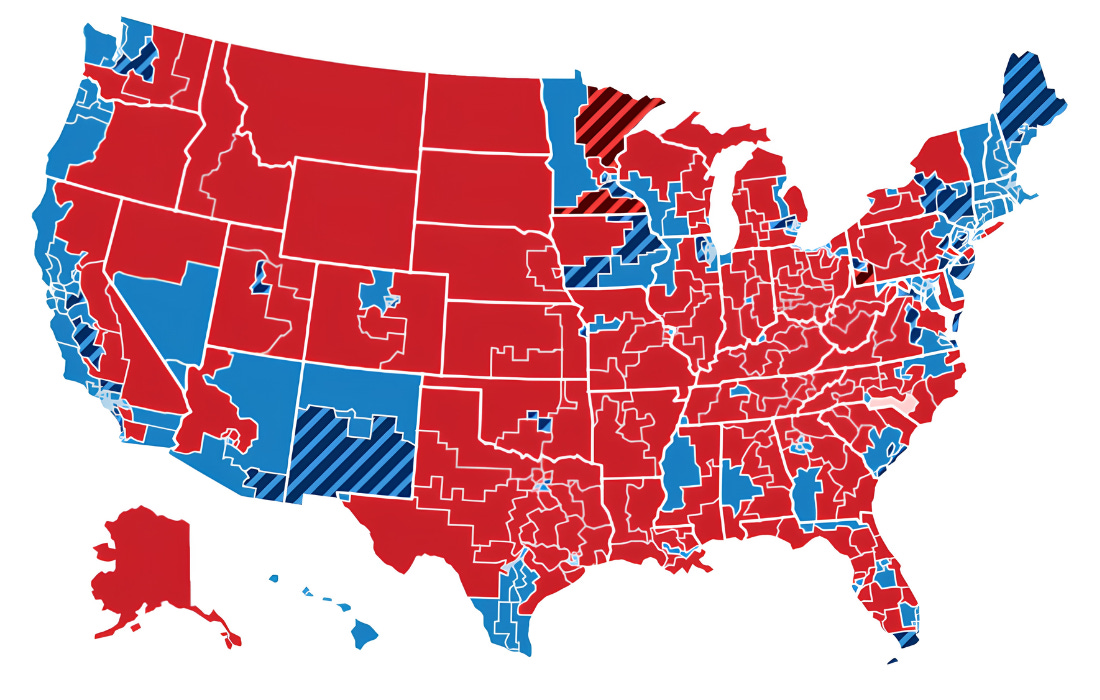
The gerrymandering arms race has begun to heat up in a way history hasn’t yet seen. Texas was the first to move forward with mid-census redistricting, and further spread to Missouri, North Carolina, Virginia, Ohio, California, Utah, Florida, and Tennessee. This piece is not about which side wins in this new, unprecedented arms race. Rather, it analyzes the unintended (or maybe intended) consequences for the future of democracy. With the development and implementation of Artificial Intelligence, the “art” of gerrymandering is no longer the crude science it once was. The new era of mid-census redistricting is data science, one that will be wielded when any party deems it necessary for the “good of the country.” Democracy requires work, and the preservation of it ends when the work ceases.
Our system is built on precedent, and the funny thing about precedent is that everything is unprecedented until it isn’t. This fight began with Republicans, but it won’t end with them. Some will argue that the only option is to gerrymander back, that without it, their party will lose, that democracy prevails in the end, that the country will be better off in the long run, or that it began with the other first. All of these arguments ring hollow and conveniently overlook the whole fucking point of our system: winning isn’t a sure thing, but punishment for poor policy is. The House was designed to reflect the immediate will of the people; the Senate was designed to slow that will down. Gerrymandering corrupts the first half of that bargain by making the House less responsive to the people it was built to mirror.
AI Supercharged Gerrymandering
In Utah State Legislature v. League of Women (2025), the Utah Supreme Court threw out a congressional map that “is an extreme partisan outlier—more Republican than over 99% of expected maps drawn without political considerations” (2) and violated Proposition 4, a constitutionally protected proposition passed by a majority of Utah voters in 20181. In Kegan’s dissent in Rucho v. Common Cause (2019), the Justice wrote (10),
“The effect is to make gerrymanders far more effective and durable than before, insulating politicians against all but the most titanic shifts in the political tides. These are not your grandfather’s—let alone the Framers’—gerrymanders… gerrymanders will only get worse (or depending on your perspective, better) as time goes on—as data becomes ever more fine-grained and data analysis techniques continue to improve. What was possible with paper and pen—or even with Windows 95—doesn’t hold a candle (or an LED bulb?) to what will become possible with developments like machine learning.”
Kegan echoes the concerns of many democracy scholars. Tyler Simko is using artificial intelligence and large amounts of data to correct the inequalities produced by gerrymandering2. However, such tools can also be used to entrench a party’s control. Philip Wang wrote in a piece for Time Magazine, “[Simko] pointed to a state as vast as Texas, which needs to fit over 9,000 voting precincts into 38 voting districts. There are trillions of possible maps that can be theoretically drawn. AI can generate nearly all of those maps within a few minutes to an hour.” States such as California, New York, and Illinois are known to use highly sophisticated systems and data-driven mapping to maximize Democratic seats. After President Trump called for Texas to find five seats, other Republican states followed, developing highly sophisticated systems to disenfranchise Democratic voters. David Myers lists some of the worst gerrymanderings of the 2020s, and what you’ll find is that gerrymandering isn’t partisan, although some states participate in the practice more than others. This race to disenfranchise the other first only leaves our country “cracked and packed,” further eroding the pillars of American democracy.
Possible Remedies
State constitutional amendments banning mid-decade redistricting: Although this doesn’t end partisan gerrymandering, something of the kind would hold Congress accountable to changes in voting behavior across the decade. This seems like the most realistic remedy in the short run, although it doesn’t solve the problem in the long run. Virginia is a great example of how state procedures matter, and the introduction of ballot initiatives in the states below could end mid-census redistricting:
Arizona, Arkansas, California, Colorado, Florida, Illinois3, Massachusetts, Michigan, Mississippi4, Missouri, Montana, Nebraska, Nevada, North Dakota, Ohio, Oklahoma, Oregon, and South Dakota
Citizens in these states could also propose initiatives to ban partisan gerrymandering, but the fight to do so would be a more difficult one.
State court litigation under state constitutions: After Rucho v. Common Cause (2019), the federal courts have largely stepped back from partisan gerrymandering claims under the U.S. Constitution. This isn’t to say that courts are irrelevant, but that the fight largely moved to state constitutions. State constitutions usually have stronger language on free elections, voting rights, and niche issues (such as gerrymandering). This means state courts are more likely to remedy problems that started in states and remain under the control of states.
Ban partisan data in map-drawing: This is a more practical reform that would ban the use of partisan election data, incumbent addresses, or voter-party modeling to draw congressional maps. This again would likely have to happen on the state level, but Congress itself could introduce similar reforms if the two parties could ever agree.
Use anti-retaliation ballot language: This is more of a political strategy than reform, but the use of phrases like “end gerrymandering forever” should be framed like “stop politicians from changing the rules mid-game.” This would pull on the common sentiment that politicians are power-hungry individuals, and it is up to citizens to keep their ambitions in check. Groups that fight gerrymandering or advocate for fair redistricting reform could benefit by making this an issue of the people rather than an issue of one party’s action at a particular moment in history.
These are only a few ways to fix the systemic problem that is partisan gerrymandering, but they are reforms that need to be considered. Tyler Simko’s idea to use artificial intelligence to draw more proportional congressional maps can help combat the use of AI for more devious purposes, but for a strategy like this to become a standard, reforms must be made to ensure the tools are used in the appropriate capacity. Gerrymandering disenfranchises each American, regardless of partisan affiliation, and the fight against such disenfranchisement should be the priority of each voter. Today, it may be Republicans, tomorrow, it may be Democrats, but each new offender only erodes the pillars of our democracy and makes those in office less accountable to their constituents.
In 2018, Utahns exercised their fundamental constitutional right to alter or reform their government via an initiative that, among other things, banned partisan gerrymandering and ensured that voting maps adhered to neutral criteria like respecting county and municipal lines, compactness, and communities of interest. That initiated law, known as Proposition 4 (“Proposition 4”), was expansive in scope, reflecting the people’s desire to use all available tools, data, and metrics to identify and prohibit increasingly sophisticated gerrymandering schemes (1). — Utah State Legislature v. League of Women (2025)
Limited to structural/procedural changes to the legislature.
Important caveat: Mississippi’s initiative process was invalidated by the state supreme court in In Re Initiative Measure No. 65 (2021) and has not been fully restored.